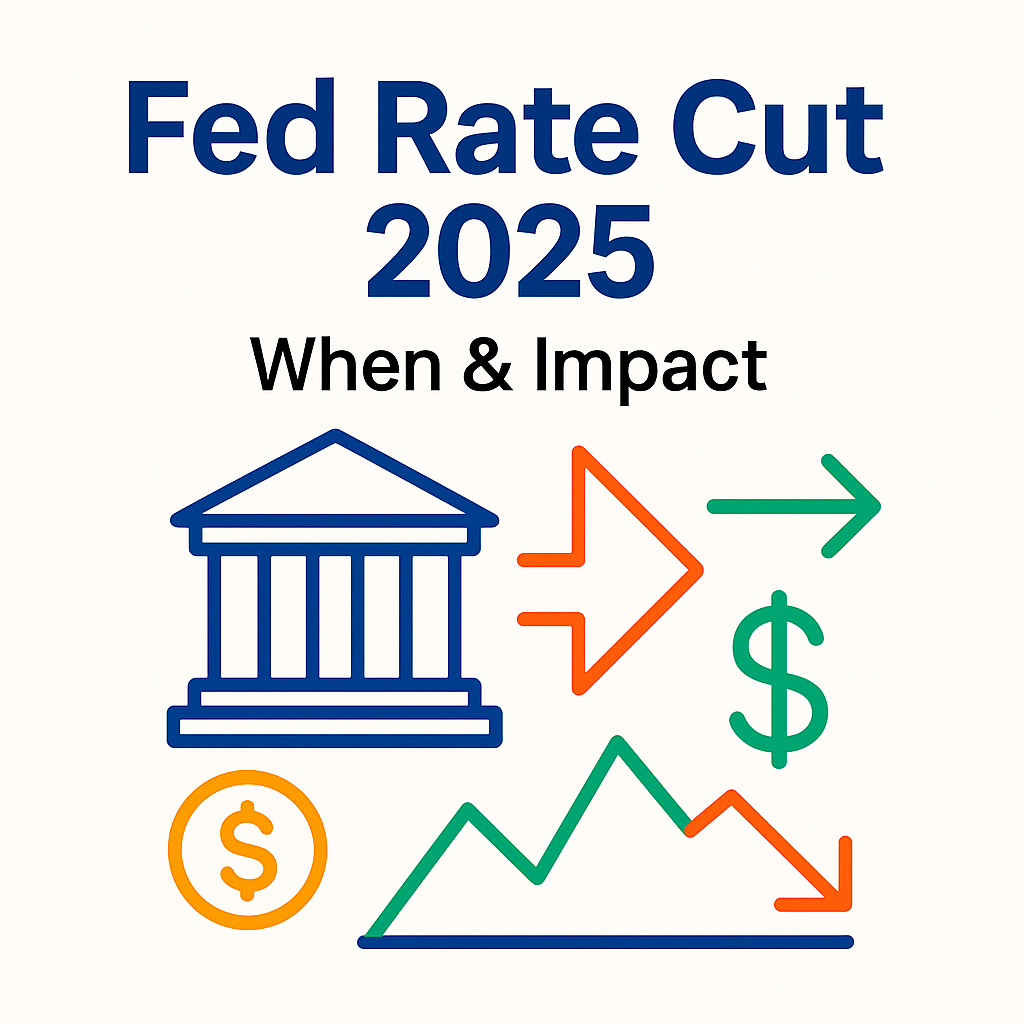
Fed Rate Cut Timing 2025: When Will the Fed Lower Rates and What’s the Impact?
The Fed is widely expected to start cutting rates in September 2025. Learn how the timing of rate cuts, inflation risks, and job market weakness will affect households and investors.
Key Takeaways
✔ The Fed is likely to cut rates by 25 bps at the September 2025 FOMC meeting
✔ Jobless claims hit 263,000, the highest in nearly four years, showing labor market slowdown
✔ Core inflation is stuck above 3%, creating risks for aggressive rate cuts
✔ Rate cuts ease borrowing costs but reduce savings yields
✔ Risks ahead: tariffs, supply chain issues, and higher inflation expectations
Why Fed Rate Cuts Matter in 2025
The timing of Fed rate cuts in 2025 has become a central question for markets and households. Inflation remains sticky, with CPI rising 2.9% year over year in August and core inflation holding at 3.1%. Meanwhile, jobless claims surged to 263,000, the highest since 2021.
This combination of elevated inflation and a slowing job market puts the Federal Reserve in a delicate position. A Fed rate cut in September 2025 could ease borrowing costs, but the risk of fueling inflation remains.
Recent Federal Reserve Policy and September 2025 Expectations
For most of 2025, the Federal Reserve kept interest rates at 4.25–4.50% to fight inflation above its 2% target. But the job market slowdown is changing the outlook.
Labor data revisions wiped out 911,000 jobs from the past two years. Job growth is slowing, and unemployment claims are climbing. Markets now expect a 25 bps rate cut at the September 16–17 FOMC meeting, with another cut possible by December 2025.
Inflation and Job Market Data Driving Fed Policy
|
Indicator |
Latest (Aug 2025) |
Trend |
What It Means |
|---|---|---|---|
|
CPI |
2.9% |
Up from 2.7% in July |
Inflation shows signs of re-acceleration |
|
Core CPI |
3.1% |
Stuck above 3% |
Still above Fed’s 2% target |
|
Jobless claims |
263,000 |
Four-year high |
Labor market slowdown |
|
Jobs revision |
–911,000 |
Downward adjustment |
Economy weaker than thought |
These numbers highlight the Fed’s dilemma: inflation is not fully under control, but job losses are mounting. The timing of rate cuts in 2025 reflects this balance.
Expert Opinions on the Fed’s September 2025 Rate Cut Forecast
- James Knightley, ING: “Labor market weakness is now outweighing inflation fears, strengthening the case for cuts.”
- Reuters survey: Nearly all 107 economists expect a 25 bps cut in September, with at least one more by year-end.
- Oxford Economics: “Inflation is still above target, but slowing jobs are shifting the Fed’s priorities.”
Experts agree: a Fed rate cut in September 2025 is almost certain, but the pace of easing will depend on inflation trends.
How a Fed Rate Cut in 2025 Affects Borrowers, Savers, Housing, and Investors
|
Group |
Expected Impact |
Positive |
Risks |
|---|---|---|---|
|
Borrowers |
Lower mortgage & credit card rates |
Reduced monthly payments |
Inflation could erode real income |
|
Savers |
Falling deposit & CD yields |
Benefit for those with existing high-rate accounts |
New deposits may underperform inflation |
|
Housing |
Cheaper mortgages boost demand |
Easier entry for buyers |
Risk of overheating prices |
|
Investors |
Bonds rally, growth stocks gain |
Tech and dividend stocks attractive |
Market volatility if cuts disappoint |
The impact of US interest rate cuts in 2025 will be felt across households, the housing market, and financial assets.
What’s Next: Timeline and Key Risks for Investors
- Timeline: The September 16–17 FOMC meeting is expected to deliver the first cut, with another possible move in December.
- Risks:
- Tariffs could raise import prices
- Supply chain bottlenecks may drive up costs
- Energy and food price shocks could reignite CPI
- A deeper labor market slowdown could tip the economy into recession
For investors, the key is not just whether the Fed cuts rates, but how quickly and how far it moves.
The timing of Fed rate cuts in 2025 is becoming clearer, with a September move looking almost certain. Still, inflation above target makes a rapid series of cuts unlikely.
Households and investors should act now:
- Consider refinancing loans to lock in lower rates
- Review savings and investments for real returns after inflation
- Adjust household budgets to prepare for lingering price pressures
References
- Reuters – September Fed rate cut a done deal, at least one more to follow by year-end
- Reuters – US consumer inflation accelerates; jobless claims approach four-year high
- AP News – Jobless claims hit highest in nearly four years
- Investopedia – The Fed Has All the Data It Needs to Cut Rates
- Federal Reserve – FOMC Calendar 2025