When the Court Moves the Market: How Trump’s Tariff Lawsuit Exposes the “Law → Market” Mechanism
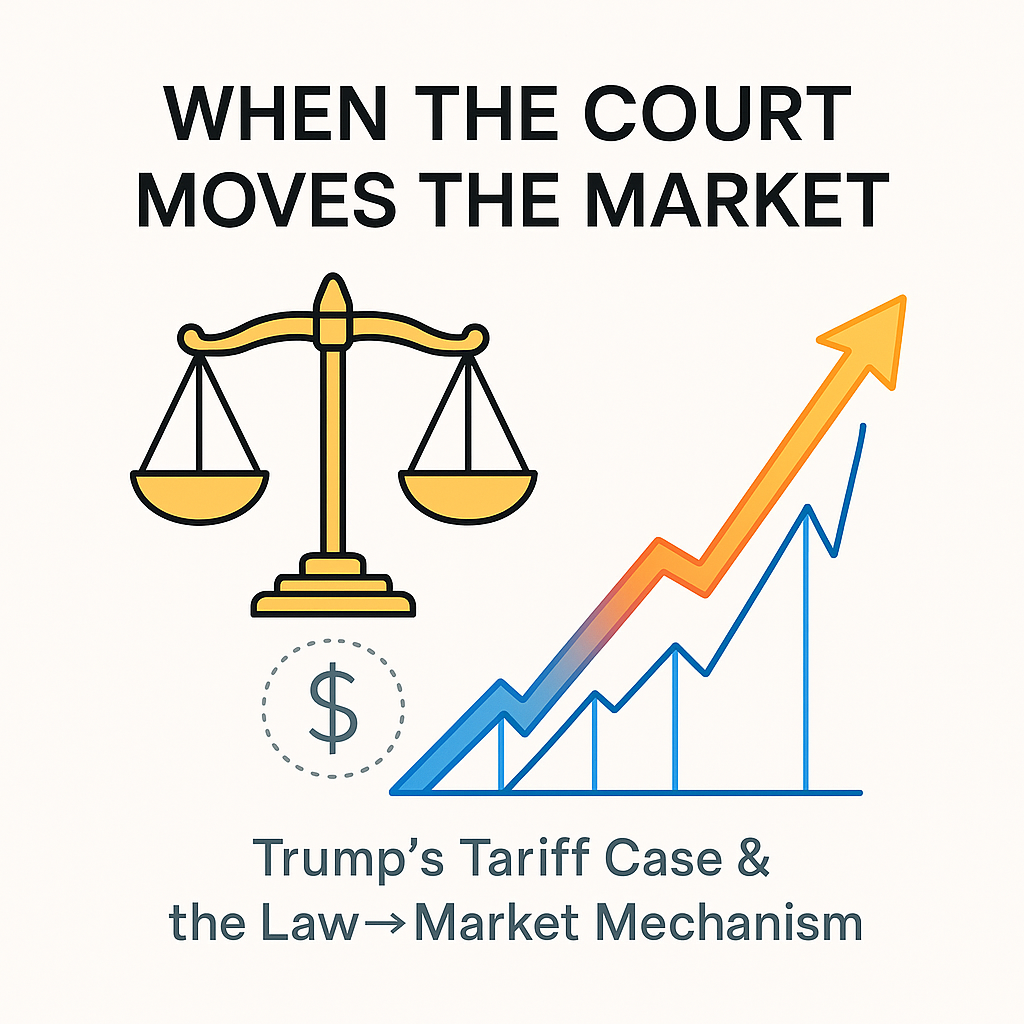
The Supreme Court’s review of Trump’s IEEPA tariffs shows how legal rulings directly move global markets. Here’s the law-to-market mechanism.
Key Takeaways
✔ The Supreme Court is now reviewing Trump’s use of IEEPA, turning trade policy into a legal risk event.
✔ When a lower court blocked tariffs in May, the S&P 500 rose 0.8% and the U.S. dollar index gained 0.4%.
✔ The Economic Policy Uncertainty (EPU) index spiked from 90 to 104 as investors priced in legal risk.
✔ Court rulings reshape risk premiums across stocks, bonds, and currencies.
✔ The case redefines how power shifts between the White House, Congress, and the market.
Trump’s Tariff Lawsuit: When Trade Policy Goes to Court
On November 5, 2025, the U.S. Supreme Court heard arguments on the legality of tariffs imposed under the International Emergency Economic Powers Act (IEEPA).
Originally intended for national security emergencies, the IEEPA was used by the Trump administration as a broad economic tool to pressure trading partners.
Now, the Court is deciding whether that move violated Congress’s constitutional power over trade. Even conservative justices questioned the scope of executive authority— and markets reacted immediately.
A single question from the bench was enough to move currencies, bond yields, and stock indexes around the world.
The 2025 Tariff Case Timeline and Market Reactions
|
Date |
Event |
Market Response |
|---|---|---|
|
Apr 2 |
Trump announces tariff expansion via IEEPA |
S&P 500 –1.3%, USD weakens |
|
May 29 |
Lower court blocks tariffs |
S&P 500 +0.8%, DXY +0.4% |
|
Aug 30 |
Appeals court calls policy “partly unconstitutional” |
Export stocks rise, oil mixed |
|
Nov 5 |
Supreme Court oral arguments |
10-year Treasury yields –3 bp, VIX –5% |
Markets now price court decisions more quickly than policy announcements. The May ruling showed how judicial risk can translate into a relief rally within hours.
How Court Decisions Move the Market
Information Shock: One Courtroom Sentence Can Reshape Expectations
Markets respond most sharply to new information. A single sentence from the bench can re-weight probabilities in investors’ models.
When the lower court called Trump’s tariffs “an overreach of executive power,” Bloomberg’s risk asset index hit a seven-month high. Legal language became a market signal.
Uncertainty Resolution: Legal Clarity Compresses Risk Premiums
Policy uncertainty is often worse than bad policy. After the ruling, the EPU index fell from 104 to 93, showing that certainty— any certainty— helps price assets more efficiently.
Bond markets echoed that shift: 10-year Treasury yields dropped 3 basis points, while S&P 500 valuations expanded 0.4 points as risk premiums narrowed.
Institutional Reset: Courts Redefine the Boundaries of Policy
If the Court limits presidential trade authority, future tariffs will require Congressional approval. That adds predictability for corporates but slows policy responses.
In effect, a judicial decision can re-draw the institutional map of economic power— a structural shift the market must price in.
Scenario Outlook: How Each Verdict Could Move Assets
|
Scenario |
Stocks |
Bonds |
U.S. Dollar |
Commodities |
Strategy |
|---|---|---|---|---|---|
|
A – Tariffs Upheld |
Defensive & domestic plays lead |
Yields edge higher |
Dollar strengthens |
Oil softens |
Favor XLP / XLU defensives |
|
B – Partially Struck Down |
Industrials & exporters gain |
Yields steady |
Mixed FX moves |
Copper & shipping up |
Tactical plays in TAN / IYT |
|
C – Fully Overturned |
Broad risk-asset rally |
Rates fall |
Dollar weakens |
Oil rebounds |
Rebalance toward VT / VWO |
ETF flows already hint at scenario B being the base case. Investors are rotating into industrial and transport funds ahead of the verdict.
Expert Insights: Courts as a New Policy Variable
“Conservative justices sounded ready to rein in the White House’s trade powers.” — Associated Press, Nov 5 2025
“The post-ruling jump in stocks and the dollar is a textbook reaction to uncertainty relief.” — Reuters Market Commentary
“Abnormal returns from Supreme Court decisions often persist for several days.” — Katz et al., Law on the Market
The pattern is clear: legal events are becoming economic events. Courtrooms now serve as real-time monitors of policy risk.
Economic Spillovers from Legal Uncertainty
Research by Baker-Bloom-Davis shows that a 10% rise in EPU correlates with a 1.2-point drop in the S&P 500 P/E ratio. Legal risk translates directly into valuation pressure.
A tariff reversal could lower import prices and trim U.S. CPI by 0.2 percentage points, according to Bloomberg Economics. That in turn may influence future Fed rate decisions.
By redrawing the limits of executive power, the Court also restores institutional trust— a long-term stabilizer even if short-term volatility rises.
Global Market Impact: Dollar, Oil, and Asia’s Exporters
Bloomberg projects that a tariff overturn would lift global trade volume by 0.4% and lower U.S. inflation by 0.2%.
A weaker dollar could boost emerging-market currencies and re-rate Asian export stocks— especially in Korea and Taiwan’s semiconductor sector.
Conversely, if tariffs stand, expect a stronger dollar, lower oil prices, and pressure on commodity-linked markets.
Investor Checklist Ahead of the Verdict
- Watch for ruling timing – expected Q1 2026; prepare for volatility.
- Track EPU vs. VIX – is policy clarity feeding risk appetite?
- Follow ETF flows – reshoring vs. global supply chain themes.
- Monitor Congressional bills – any move to reclaim tariff authority.
- Observe Dollar-Oil pairing – a mirror for trade policy expectations.
Law Is the Market’s New Interest Rate
The Trump tariff case shows that courts can move markets as surely as central banks.
When a ruling redefines policy boundaries, investors immediately reprice risk.
Legal uncertainty has become a macro variable— a hidden interest rate set by judges instead of the Fed.
Understanding these signals is now essential for navigating an era where law and markets intersect.
Law Is the Market’s New Interest Rate
The Trump tariff case shows that courts can move markets as surely as central banks.
When a ruling redefines policy boundaries, investors immediately reprice risk.
Legal uncertainty has become a macro variable— a hidden interest rate set by judges instead of the Fed.
Understanding these signals is now essential for navigating an era where law and markets intersect.