
US Inflation Near 3% and Fed Rates Around 4%: What 2025’s Policy Dilemma Means for Global Investors
US inflation remains near 3% while Fed rates sit around 4%. Here’s what the 2025 policy dilemma means for global investors and their strategies.
Key Takeaways
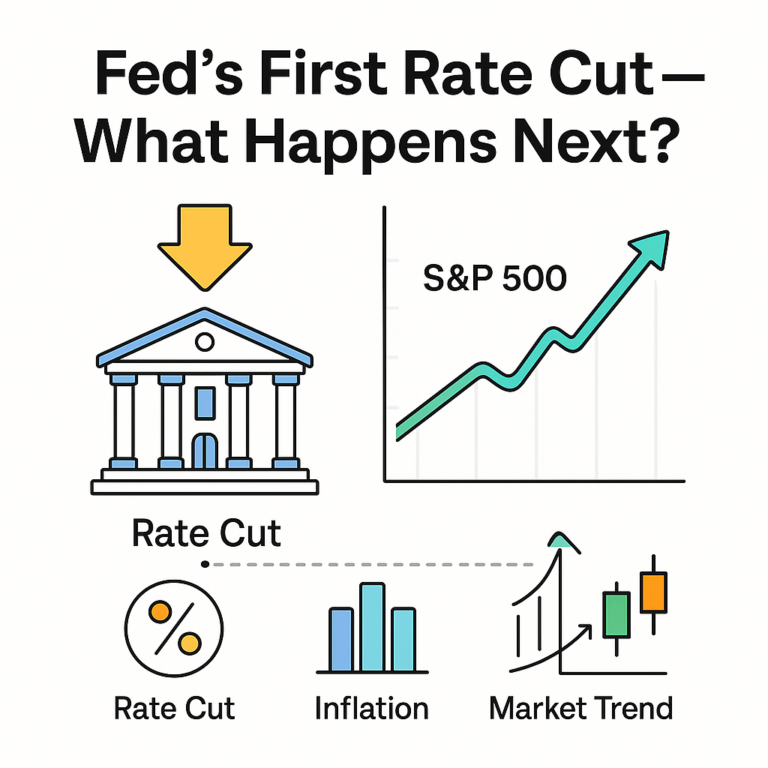
✔ The Federal Reserve cut rates to 3.75–4.00%, but future cuts are not guaranteed.
✔ US inflation continues to hover near 3%, above the Fed’s 2% target.
✔ The yield curve is shifting as long-term rates rise modestly and short-term rates reflect easing expectations.
✔ Fed officials remain divided between inflation concerns and the need for policy easing.
✔ Investors should track US Treasury yields, the dollar, growth vs value rotation, and sector-specific risks.
As 2025 draws to a close, global markets are focused on one question: How far can the Federal Reserve lower interest rates while inflation stays near 3%?
The Fed has already reduced the federal funds rate to a 3.75–4.00% range. But policymakers have avoided committing to additional cuts because inflation is cooling more slowly than expected, with key indicators stuck well above the 2% target.
This creates an unusual backdrop:
- Rates have begun to fall
- Inflation remains elevated
- Growth data is mixed
- Policy signals are inconsistent
For global investors, understanding this mix is essential. Below, the 2025 environment is broken down into clear sections with strategic insights for navigating the months ahead.
US Inflation Near 3% and Fed Rates Around 4%: What the Current Policy Coordinates Reveal
US inflation has been moving sideways near the 3% range. This makes it difficult for the Fed to justify aggressive rate cuts, even as some economic indicators point to softening demand.
The current policy rate—3.75–4.00%—sits in a zone where it is no longer “high” by historical standards but still restrictive in real terms. The Fed is trying to maintain a balance: easing just enough to avoid economic slowdown while keeping conditions tight enough to prevent another inflation flare-up.
In short, the Fed is positioned in the middle ground. Easing too quickly risks letting inflation rebound; easing too slowly risks stalling economic momentum.
Shifting Yield Curves and Long-Term Rates: What the Bond Market Is Signaling About 2025
Bond markets are offering early clues about the Federal Reserve’s next moves.
Long-term yields, particularly the 10-year Treasury, have shown mild upward pressure. This reflects expectations of:
- Slower disinflation
- Higher Treasury issuance
- Persistent fiscal deficits
Short-term yields are trending lower as markets price in potential rate cuts.
This combination is pushing the yield curve toward a gradual steepening, a pattern often seen when the economy transitions into a new cycle.
For investors, this means:
- Short-duration bonds may capture the clearest benefit from near-term rate cuts.
- Long-duration bonds carry more sensitivity to inflation and fiscal dynamics.
- Duration decisions will likely determine performance differences across fixed income portfolios.
Inflation Hawks vs. Rate-Cut Advocates: The Fed’s Internal Debate Is Becoming Louder
Recent speeches reveal widening disagreement within the Federal Reserve:
Inflation-focused policymakers argue that price pressures remain too high to justify rapid easing. They warn that premature rate cuts could reignite inflation and undermine policy credibility.
Dovish policymakers, meanwhile, highlight signs of cooling labor markets and weakening demand. They believe current rates may already be overly restrictive and could slow growth unnecessarily.
This internal split explains why the Fed’s messaging has become less predictable, leaving markets uncertain about the pace and scale of 2025 rate cuts.
Stocks, Bonds, the US Dollar, and Alternatives: How Each Asset Class Reacts to the Fed’s 2025 Dilemma
Equities: Growth vs Value Leadership
Growth stocks benefit when rate-cut expectations rise.
But a persistently high inflation environment can pressure valuations.
Value and dividend-oriented sectors—utilities, healthcare, consumer staples—tend to offer steadier performance during policy uncertainty.
Fixed Income: Duration Becomes a Key Performance Driver
- Short-term bonds may outperform if the Fed proceeds with moderate cuts.
- Long-term bonds face greater sensitivity to inflation risk and fiscal concerns.
- Credit markets may show wider dispersion as default risks rise in a slowing economy.
US Dollar & FX: A Multi-Directional Environment
Dollar trends will not be dictated solely by Fed cuts.
Inflation persistence, global risk sentiment, and geopolitical events will all influence the currency’s path.
Commodities & Alternatives
A long stretch of 3% inflation supports interest in gold, energy, and real assets as hedges.
If inflation falls rapidly in 2026, capital may shift back toward traditional equities and bonds.
Three Federal Reserve Scenarios and the Investment Strategies That Fit Each One”
Scenario A — Gradual Cuts + Gradual Disinflation
The Fed cuts rates modestly and inflation trends lower.
Strategies:
- Balanced allocation across growth and value
- Increased exposure to short- and intermediate-term bonds
- Positive environment for risk assets overall
Scenario B — Inflation Re-Accelerates and the Fed Pauses
Inflation remains sticky or rises back above 3%.
Strategies:
- Favor short-duration fixed income
- Increase exposure to defensive equity sectors
- Add select real-asset hedges (gold, energy)
Scenario C — Economic Downturn Forces Faster Cuts
Growth and employment data weaken sharply.
Strategies:
- Hold more cash and short-duration Treasuries
- Gradually accumulate high-quality assets during pullbacks
- Avoid excessive credit or speculative exposures
The most important question for 2025 is not whether the Federal Reserve will cut rates, but how quickly and under what inflation conditions it will choose to do so.
With inflation near 3% and policy rates near 4%, the next phase of market dynamics will be shaped by the interaction between growth, price stability, and policy uncertainty. Investors who prepare for multiple scenarios—rather than betting on a single outcome—will be far better positioned for the year ahead.
References
- Reuters – Fed may cut again in December but uncertainty remains
- Reuters – US cementing a higher inflation regime
- Reuters – US 10-year Treasury yields priced for no inflation surprises
- Reuters – Fed officials warn restrictive policy may still be needed
- Reuters – Global markets view: Fed cut now a coin toss
- Cleveland Federal Reserve – Inflation Nowcasting
- U.S. Bureau of Labor Statistics (BLS) – Consumer Price Index (CPI)
- Federal Reserve Economic Data – Treasury Yield Curve