Q3 2025 13F Filings: Warren Buffett’s $4.3 Billion GOOGL Bet & Michael Burry’s Shocking China Stock Portfolio Strategy
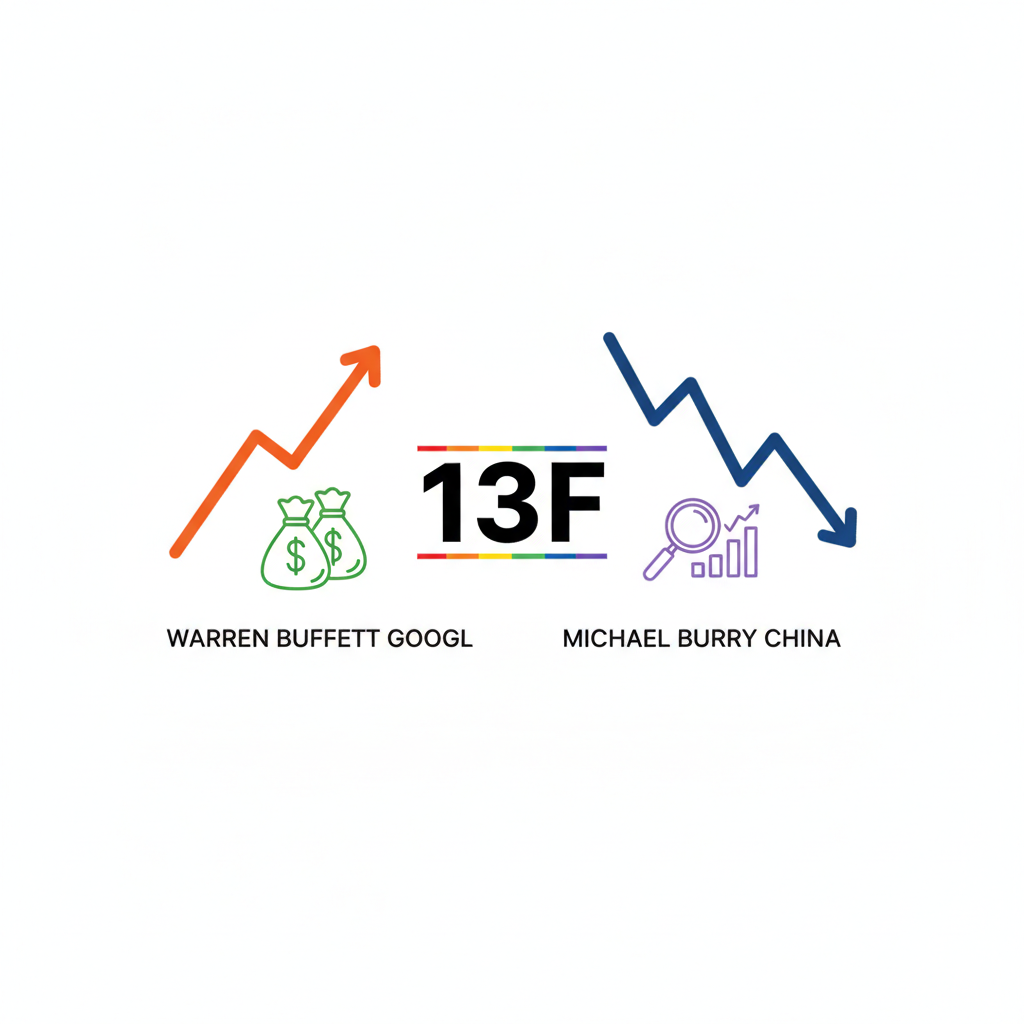
The Q3 2025 13F filings are here. Warren Buffett’s Berkshire Hathaway made a massive $4.3 billion new investment in Google (GOOGL) while trimming Apple. Michael Burry expanded his bet on Chinese tech stocks. Uncover the deep insights from these two legends.
Key Takeaways
✔ Warren Buffett (Berkshire Hathaway) initiated a massive $4.3 billion position in Alphabet (GOOGL), placing it instantly among his top holdings. This signals a belief in the longevity of Google’s AI-driven competitive moat.
✔ Buffett reduced his stake in Apple (AAPL) and financial stocks, increasing his cash reserves (estimated at $382 billion) to an all-time high, adopting a highly defensive stance against global risks.
✔ Michael Burry (Scion Asset) maintained and potentially expanded his positions in Chinese tech giants like Alibaba (BABA) and JD.com (JD), focusing on Deep Value amid market fear.
✔ The two investors show a clear contrast: Buffett focuses on defensive cash and AI platform winners, while Burry bets on oversold, undervalued assets and warns of systemic market fragility.
The actions of investing legends often serve as a crucial compass for predicting the market’s future direction. Specifically, the portfolio shifts of Warren Buffett, the “Oracle of Omaha,” and Michael Burry, the star of “The Big Short,” provide deep macroeconomic insights and actionable investment ideas for investors globally.
In mid-November, the Q3 2025 13F filings were released by the U.S. Securities and Exchange Commission (SEC). The 13F reports officially reveal the stock holdings of institutional investors managing over $100 million. They offer a transparent look at what the “big money” bought and sold between July 1st and September 30th.
This particular filing carried extra significance. Buffett’s move to initiate a staggering $4.3 billion new position in Alphabet (GOOGL) sent shockwaves through the financial world. It represents a powerful statement on his view of the winners in the escalating AI race.
In stark contrast, Michael Burry, a known market pessimist, simultaneously maintained his large positions in Chinese tech stocks. This strategy showcases a characteristic contrarian move into an area the rest of the market fears.
This article provides a detailed analysis of the two titans’ Q3 portfolios. We will explore the core strategic shifts and the underlying economic philosophies guiding their investment decisions in the current market environment.
Warren Buffett’s Final Play: The GOOGL Bet and the AI Moat Strategy
The most distinctive features of the Berkshire Hathaway Q3 portfolio were the record-high cash pile (estimated at $382 billion) and the unexpected, substantial new position in Alphabet (GOOGL). Given Buffett’s historical caution with tech stocks, this massive investment reflects his strategic response to evolving market dynamics.
A. Alphabet as the New, Indispensable Economic Moat
Buffett’s investment philosophy centers on finding companies with an enduring “economic moat”—a competitive advantage that rivals cannot easily breach. The Alphabet acquisition suggests Buffett views Google’s dominant search engine monopoly and the Android ecosystem as the most resilient infrastructure in the accelerating AI era.
Google’s powerful AI technology, such as “Gemini,” promises a long-term competitive edge. Buffett is betting on the company that possesses the foundational platform for this technological revolution.
B. Defending Against High Rates: Cash Flow Stability
The ongoing possibility of “Higher for Longer” interest rates poses a challenge to future growth stocks. In this environment, Buffett prioritizes companies with certain, current cash flow generation over uncertain future expectations.
Google’s advertising revenue stream is highly recession-resistant. Companies are often reluctant to slash core advertising budgets, making Google’s cash flow stable, even during economic slowdowns. By investing in this resilient cash cow, Buffett aims to fortify the portfolio’s defense amid prolonged high-rate uncertainty.
C. Trimming Apple and Financials: Preemptive Risk Hedge
Berkshire reduced its stake in Apple (AAPL) slightly (by about 6%) and continued to trim positions in financial stocks, including Bank of America (BAC). This is interpreted as a clear strategy for risk management, not merely profit-taking.
Apple, with its significant dependency on the Chinese market for both production and sales, is highly exposed to geopolitical risk stemming from US-China tensions. By reducing the exposure of his largest holding, Buffett is executing a preemptive hedge against global supply chain volatility. (Source: CNBC, 2025.11.15)
Michael Burry’s Contrarian Move: Betting on Deep Value in Chinese Tech Stocks
Michael Burry’s Scion Asset Management maintains a striking contrast to Buffett’s caution. Burry’s Q3 strategy confirms his focus on contrarian, deep value investing, particularly in Chinese tech stocks like Alibaba (BABA) and JD.com (JD).
A. Exploiting the Extreme Discount in Chinese Tech
Burry’s investment rationale centers on exploiting the discrepancy between price and intrinsic value created by market fear.
Chinese Big Tech stocks have traded at significantly lower Price-to-Earnings (P/E) and Price-to-Book (P/B) ratios compared to their US counterparts. This is largely due to past government regulation and economic slowdown fears.
Burry sees this extreme undervaluation as a prime opportunity. He believes that the strong market dominance and immense cash-generating capabilities of these companies will inevitably be reflected in their stock prices eventually.
B. The Systemic Risk Warning: Maintaining Short Positions
Despite his deep value bets in China, Burry maintained a large short position against the broader US market, using specific ETFs. This is not just a short-term bearish forecast. It reflects his fundamental skepticism regarding systemic risk due to prolonged high interest rates.
Burry warns that the delayed effects of tight monetary policy could lead to a credit crunch and failure in the wider financial system. While Buffett uses cash as a defense, Burry uses aggressive short positions as an insurance policy against a potential market collapse. (Source: DigitalToday, 2025.11.05)
Q3 2025 Investor Portfolio Shifts: A Summary of Macro Insights
The Q3 13F filings vividly illustrate the divergent macro perspectives of these investment legends.
|
Investor |
Firm |
Core Q3 Action |
Key New/Increased Holdings |
Key Reduced/Sold Holdings |
Core Investment Message |
|---|---|---|---|---|---|
|
Warren Buffett |
Berkshire Hathaway |
Record Cash, New GOOGL Investment |
Alphabet (GOOGL) – $4.3B new position, Occidental Petroleum (OXY) |
Apple (AAPL) – minor trim, Bank of America (BAC) |
Defense First: Investing in AI winners while hedging global risks. |
|
Michael Burry |
Scion Asset |
China Tech Holdings Maintained, US Short Maintained |
Alibaba (BABA), JD.com (JD) – maintained/increased positions |
Regional Banks, some retailers (Managing volatility) |
Contrarian Value: Finding opportunity in deeply undervalued, feared assets. |
The Q3 2025 13F filings, featuring Warren Buffett’s new GOOGL bet and Michael Burry’s contrarian China strategy, clearly signal that the current market is at a complex inflection point. Buffett is adopting a highly defensive portfolio centered on cash and guaranteed platform winners. Burry is simultaneously capitalizing on oversold opportunities while maintaining his alarm about potential systemic fragility.
Individual investors should not just replicate these stock picks. Instead, focus on the macroeconomic insights—how these giants are managing risk against global uncertainty and positioning for the long-term direction of technological innovation (AI). Investment success ultimately hinges on finding your own well-balanced approach amid these contrasting signals.
Reference Links
- U.S. Securities and Exchange Commission (SEC) – Official 13F Filings
- CNBC News – Berkshire Hathaway Q3 13F Analysis
- Yonhap Infomax – Michael Burry China Hedging Analysis