
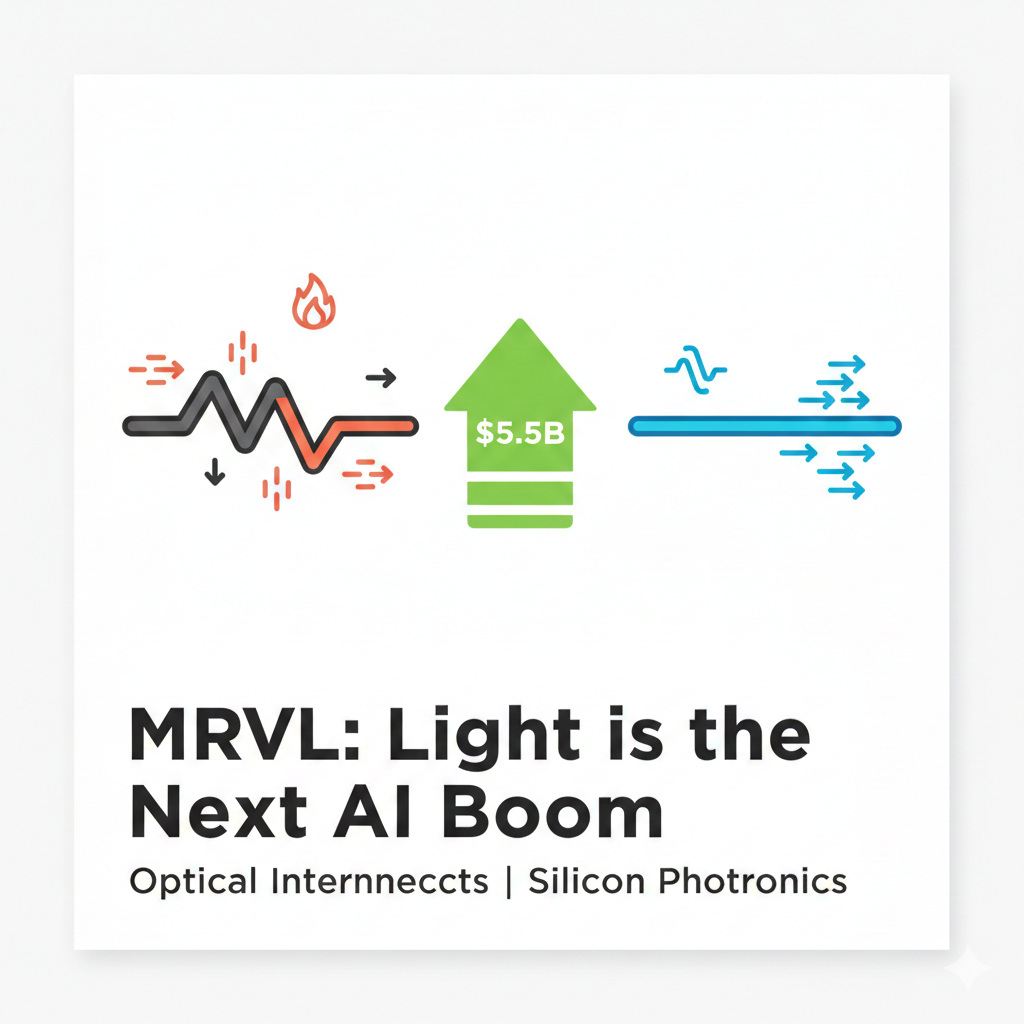
Is Light the Next Nvidia? Marvell’s (MRVL) $5.5 Billion Bet and the Second AI Hardware Boom
Marvell (MRVL) is acquiring Celestial AI for up to $5.5B, signaling the shift from GPU computing to optical connectivity. We analyze the core technology, Silicon Photonics, and the potential investment opportunity for MRVL stock.
Key Takeaways
✔ Game-Changing M&A: Marvell Technology (MRVL) announced the acquisition of optical interconnect leader Celestial AI for a total value of up to $5.5 billion.
✔ Paradigm Shift: The focus of AI hardware is quickly moving from sheer processing power (Compute) to solving data transfer speed and efficiency (Connectivity).
✔ Core Technology: Celestial AI’s ‘Photonic Fabric’ uses light instead of electricity to drastically reduce power consumption and solve the persistent data bottleneck.
✔ Investment Thesis: This acquisition positions Marvell alongside Broadcom (AVGO) and Nvidia (NVDA) as one of the three primary architects of next-generation AI infrastructure.
If you missed out on the phenomenal growth of Nvidia, you know one key truth: smart investors look for the next bottleneck.
As of December 2, 2025, a massive piece of news confirmed where the smart money is moving. Marvell Technology (Ticker: MRVL), a leader in data infrastructure semiconductors, announced its intent to acquire Celestial AI, a pioneer in optical interconnects.
The deal’s value is staggering: up to $5.5 billion (approximately $7.5 trillion KRW) including earn-out incentives.
Why would Marvell pay such a premium for a relatively young startup? The answer lies in the critical crisis facing every modern AI data center: The limitations of copper, heat, and speed. Marvell is betting that the future of data transfer is not electric, but light. This move signals the start of the Second AI Hardware Boom.
The $5.5 Billion Strategic Pivot: What Marvell Purchased
This M&A is more than a simple expansion; it is a profound strategic pivot. Marvell is paying an initial sum of approximately $3.25 billion (cash and stock) with additional performance-based payouts, valuing Celestial AI’s proprietary technology highly.
The core asset Marvell is acquiring is Celestial AI’s ‘Photonic Fabric’ platform. Even the fastest Nvidia GPUs hit a wall when transferring enormous amounts of data between chips or between memory and the processor. This is known as the ‘Memory Wall.’
Celestial AI’s IP creates pathways for light within the chip, effectively bypassing the electric bottleneck. This move signals Marvell’s intent to dominate the crucial data connectivity layer.
Why Optical Interconnects Are Non-Negotiable (The End of Copper)
For decades, basic data center connectivity relied on copper cables. They were cheap and reliable. However, the scale and speed requirements of large language models (LLMs) have pushed copper past its physical limits.
Two major flaws make copper unsustainable for future AI scaling:
- Unacceptable Power Consumption: As data transmission rates increase, copper generates massive resistance and heat. A significant portion of a modern data center’s electricity is wasted simply fighting this heat, not on actual computing.
- Distance and Latency Constraints: High-speed signals degrade rapidly over copper, limiting reliable connection distances to only a few meters. This severely restricts how large AI clusters can be built.
As Marvell CEO Matt Murphy emphasized, “The next frontier for AI scale-up lies in connectivity.” The battle is shifting from who can calculate the fastest to who can connect components the fastest and most efficiently.
The Competitive Landscape: Marvell’s Path to AI Infrastructure Leadership
The market for this next-generation technology—often discussed using keywords like Silicon Photonics and Co-Packaged Optics (CPO)—is highly competitive.
- Broadcom (AVGO): A dominant force in traditional networking, already holding a strong position in the CPO switch market.
- Nvidia (NVDA): Utilizing its proprietary NVLink technology, Nvidia aims for full vertical integration, controlling both compute and connectivity.
- Marvell (MRVL): The Celestial AI acquisition transforms Marvell from a strong DSP (Digital Signal Processing) chip supplier into an integrated platform provider. Marvell can now offer a complete optical solution, strongly positioning it as a key partner for data centers seeking alternatives to Nvidia’s closed ecosystem.
Marvell projects that revenue contributions from Celestial AI will begin in the second half of the 2028 fiscal year, with expectations to generate over $1 billion in annual revenue by fiscal year 2029.
Traditional Copper vs. Optical Interconnects
|
Comparison Factor |
Traditional Copper (Electrical) |
Next-Gen Optical (Photonics) |
|---|---|---|
|
Transmission Medium |
Copper Wires (Electron Movement) |
Fiber Optics / Waveguides (Light Movement) |
|
Power Efficiency |
Low (High heat generation, high cooling costs) |
Extremely High (Low power, minimal heat) |
|
Transmission Distance |
Limited (Max a few meters at high speed) |
Long Distance (Signal maintained over kilometers) |
|
Bandwidth Density |
Near physical limits |
10x or more expansion capability |
|
Latency |
Prone to signal interference and delay |
Ultra-low (Data moves at the speed of light) |
|
Key Application |
Older servers, short intra-rack connections |
Massive AI Clusters, HBM Memory Stacking |
Marvell Technology’s aggressive $5.5 billion move is a clear confirmation that the AI industry is undergoing a structural shift. The focus is moving from Compute to Connect. The future winners will be the companies that solve the monumental challenges of power consumption and data transfer efficiency.