Is the U.S. Economy Really Still Strong? Conflicting Expansion Signals vs. Slowdown Indicators
The U.S. economy shows strong PMI expansion yet weakening leading indicators. Here’s why mixed signals are rising in 2025.
Key Takeaways
✔ U.S. PMI readings show solid expansion, outperforming other major economies.
✔ The Leading Economic Index (LEI) is down –2.8% over six months, signaling future slowdown risks.
✔ Consumer expectations have fallen below the recession threshold, reflecting rising uncertainty.
✔ A prolonged shutdown created major data gaps, especially in jobs and inflation reports.
✔ Fed officials are split on future rate cuts, adding more volatility to markets.
The 2025 U.S. economy is sending a mix of signals that are difficult to interpret at a glance.
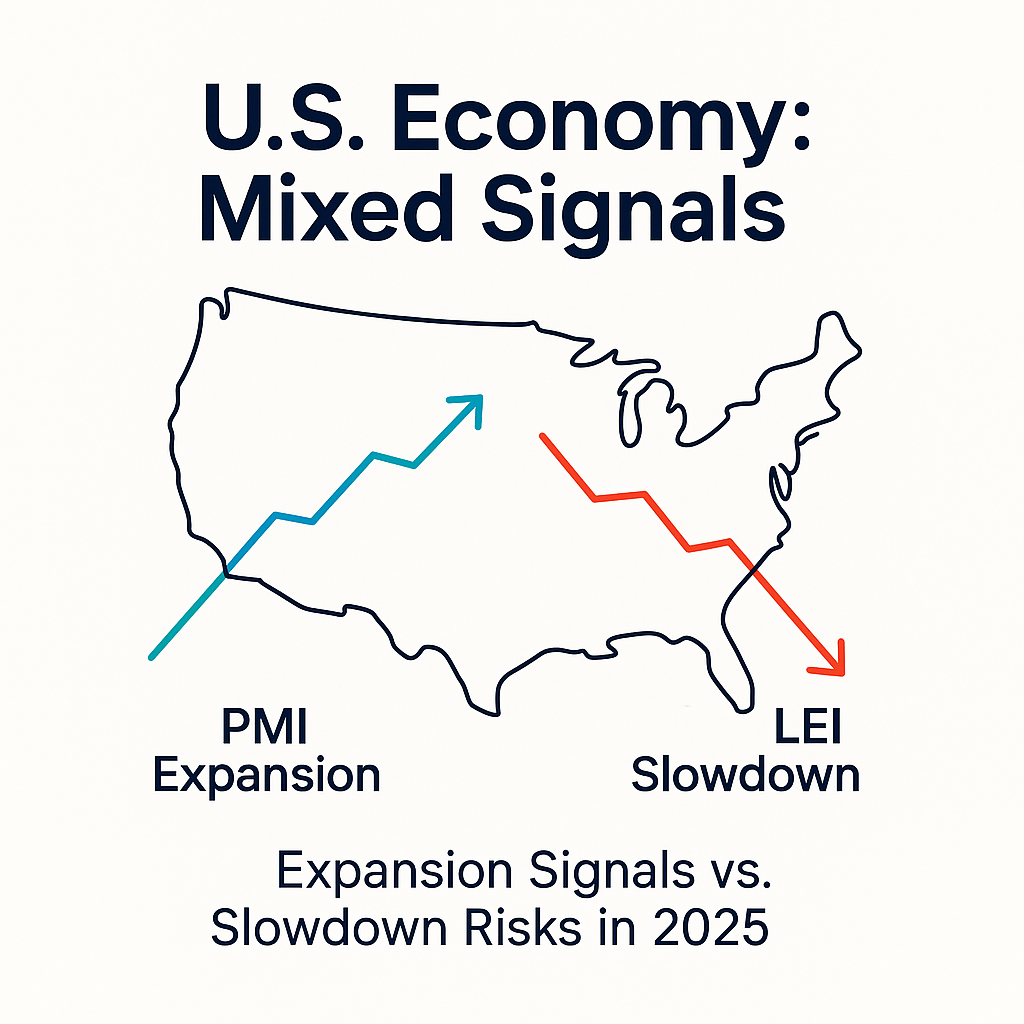
On one hand, PMI readings show strong expansion across both manufacturing and services.
On the other hand, leading indicators, consumer expectations, and early job-market data point toward mounting economic fragility.
These contradictions are not random.
They reflect a deeper divide between current economic momentum and the weakening foundations that shape future growth.
This article breaks down why the U.S. economy appears strong today yet increasingly vulnerable in the coming months.
Post-Pandemic Economic Phases: From Rapid Recovery to Gradual Cooling
After the pandemic, the U.S. economy moved through three clear phases.
Phase 1 (2021–2022): A rapid rebound driven by massive fiscal stimulus and near-zero interest rates.
Phase 2 (2023–2024): Aggressive tightening as the Federal Reserve fought the strongest inflation shock in decades.
Phase 3 (2025): Growth remains intact, but the pace is slowing as the effects of high rates spread through the economy.
This transition naturally creates a gap between short-term activity data, which still looks strong, and medium-term indicators, which are turning weaker.
PMI, Consumer Spending, and Growth Data Still Point to a ‘Strong U.S. Economy’ in 2025
The most immediate indicators tell a clear story: the U.S. economy continues to outperform its peers.
Manufacturing PMI remains above 50, while services PMI is near 55—firmly in expansion territory.
These numbers suggest that new orders, employment intentions, and business activity remain healthy.
Compared to Europe, the U.K., and Japan—where momentum has been soft—the U.S. maintains a noticeable growth premium.
Even corporate earnings and household spending have come in stronger than expected in several recent quarters.
In short, the “right now” picture of the U.S. economy still looks resilient.
Leading Indicators, Consumer Expectations, and Job Trends Warn the Slowdown Is Ahead
The forward-looking view is very different.
The Leading Economic Index (LEI) has fallen –2.8% over the latest six-month period.
Historically, declines of this magnitude have signaled weaker growth 6–12 months ahead.
Consumer expectations tell an even clearer story.
The expectations index dropped to 71.5, well below the recession-risk threshold of 80.
Americans feel relatively stable today, but they are increasingly worried about the future.
The job market adds another layer of uncertainty.
Because of the prolonged government shutdown, key labor reports were never published, leaving a gap in the data the Fed relies on.
Private surveys show rising layoffs and an uptick in the unemployment rate—early signs that the labor market may be softening.
Together, these shifts explain why the U.S. economy feels strong in the present but fragile in the months ahead.
The Shutdown’s Data Gap Has Created a Blind Spot for Policymakers
One of the most unusual risks in 2025 is the statistical blind spot caused by the federal shutdown.
Key releases—such as the Household Survey, unemployment rates, and components of CPI—were delayed or canceled.
This leaves the Federal Reserve without a complete view of the labor market and inflation as it prepares for critical policy decisions.
At the same time, Fed officials are increasingly divided.
Some argue that weakening job trends justify easing, while others emphasize sticky service-sector inflation and resist early cuts.
This combination—missing data and policy disagreement—raises volatility in both the bond market and equities.
It also makes forecasting significantly harder for households, businesses, and investors.
What ‘Strong Yet Fragile’ Means for Investors: Three Strategic Takeaways
1. Keep exposure to long-term growth sectors.
The U.S. still shows stronger short-term activity than other major economies, supporting selective exposure to AI, semiconductors, and health-tech.
2. Strengthen risk management and diversify.
With leading indicators falling and sentiment weakening, portfolios concentrated in high-beta tech or cyclicals may become vulnerable to abrupt shocks.
3. Separate short-term and medium-term views.
The next six months may bring continued resilience, but the 12–24 month horizon shows rising slowdown risks.
This is a period where both growth positioning and defensive hedges matter.
The 2025 U.S. economy is defined by dual realities.
PMI readings and consumer activity point to ongoing expansion, while leading indicators and expectations suggest rising downside risks.
Understanding this divide is essential for building a balanced portfolio and preparing for higher volatility ahead.
References
- “Why The U.S. Economy Looks Strong But Feels Fragile” – Forbes
- “October flash PMIs show US sustaining its lead among the developed economies” – S&P Global
- “US Leading Indicators” – The Conference Board
- “Fed minutes expected to detail policy divide that may be deepening” – Reuters
- “Unconstrained fixed income views – November 2025” – Schroders
- “US government to skip October jobs report due to shutdown” – BusinessTimes