SoftBank’s $5.8 Billion Nvidia Stake Sale: Warning Sign or Strategic Move?
SoftBank sold its entire $5.8 billion Nvidia stake, sparking AI bubble fears. Here’s why this move looks more like a strategic pivot toward AI infrastructure than an exit. (150 characters)
Key Takeaways
✔ SoftBank sold 32.1 million Nvidia shares worth $5.8 billion in October 2025.
✔ The sale wasn’t about losing faith in Nvidia—it was about raising cash for AI infrastructure and OpenAI-related projects.
✔ Nvidia shares dipped 3 % after the news, reigniting AI bubble and valuation concerns.
✔ Analysts see the move as part of a broader shift from AI chips to AI infrastructure.
✔ Investors should look beyond semiconductors toward data-center, energy, and cloud opportunities.
A $5.8 Billion Move That Shook the Market
When SoftBank Group announced the sale of its entire Nvidia stake in late October 2025, the global market took notice.
At $5.8 billion, the divestment raised immediate questions: Was this a sign of fading confidence in AI chips—or a calculated reallocation of capital?
SoftBank clarified that the sale aimed to free up liquidity for OpenAI and large-scale AI infrastructure projects, not to exit the AI race.
Still, the move came just as investors were debating whether AI stocks had gone too far, too fast.
For markets already jittery over valuation risk, SoftBank’s decision served as both a signal and a test of sentiment.
SoftBank’s “Second Exit” from Nvidia — A Pattern of Tactical Timing
SoftBank first invested in Nvidia back in 2017, selling out in 2019 for a substantial profit—only to return amid the AI boom.
This October, it made a second full exit, unloading all 32.1 million shares at an average of about $182 per share.
Masayoshi Son described the decision as part of a larger strategy to pivot toward AI applications, data-center capacity, and energy-intensive infrastructure.
In other words, SoftBank wasn’t retreating—it was moving upstream, from chip fabrication to the ecosystems powering artificial intelligence.
Many analysts see this as another example of Son’s “strategic timing” playbook—taking profits at elevated valuations while re-positioning for the next growth curve.
Breaking Down the Numbers — Valuation, Market Reaction, and Reinvestment Plans
|
Category |
Detail |
Insight |
|---|---|---|
|
Shares sold |
≈ 32.1 million |
Complete stake sale |
|
Total value |
$5.8 billion |
Avg. price ≈ $182 per share |
|
Pre-sale high |
≈ $212 per share |
≈ 15 % below peak |
|
Stock reaction |
-3 % intraday drop |
Triggered sector pullback |
|
Cash use |
OpenAI, “Stargate” AI data centers |
Liquidity for AI infrastructure |
The sale happened near Nvidia’s all-time high but before its latest earnings run-up—suggesting SoftBank saw limited near-term upside.
Rather than calling the top, it converted paper gains into capital for long-term AI infrastructure investments.
Bloomberg reported that SoftBank views the next stage of AI growth as less about chip supply and more about power, data, and compute capacity.
Analyst Perspectives — Bubble Avoidance or Portfolio Rebalancing?
Market strategists are split on interpretation.
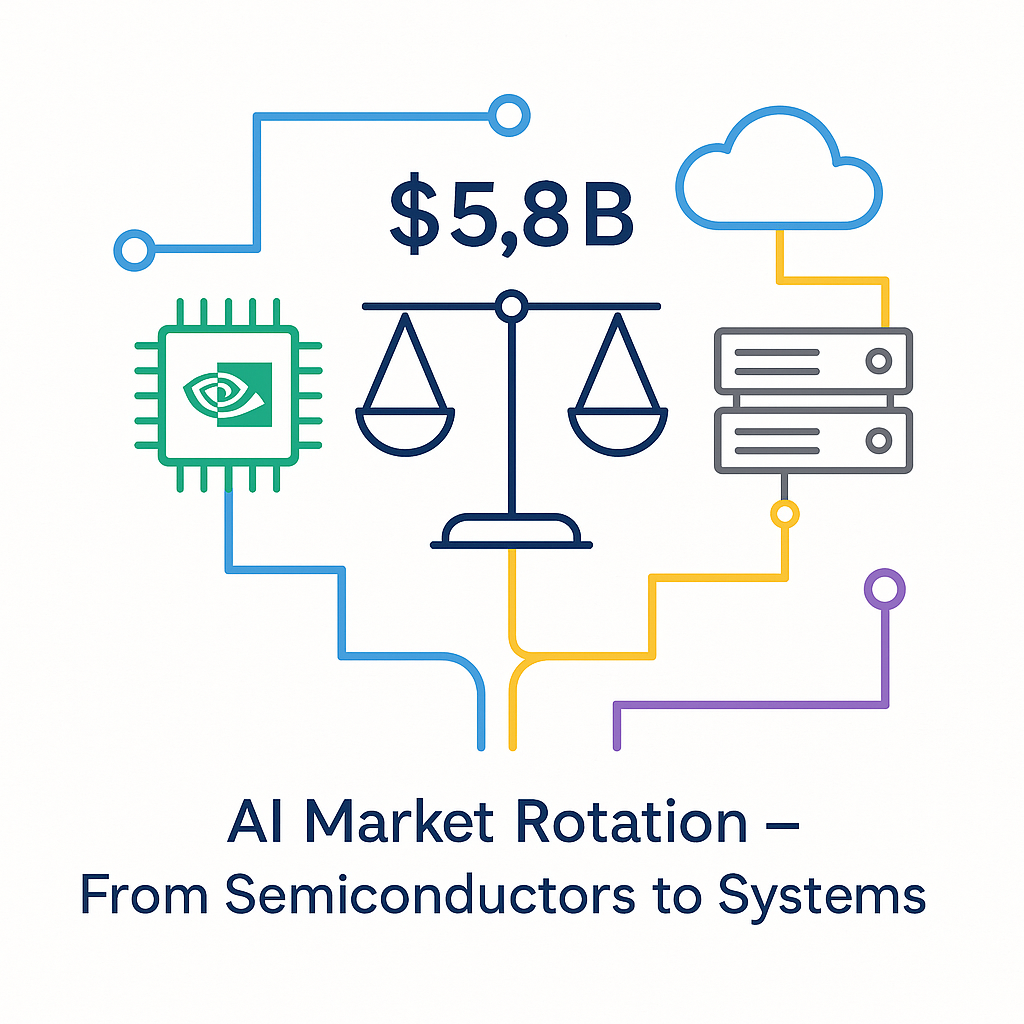
Cantor Fitzgerald called it “a rotation from AI chips into infrastructure and applied AI growth.”
Russ Mould of AJ Bell added, “Investors trim positions when valuations stretch or when they see something better—SoftBank clearly sees the latter.”
Far from signaling doubt in Nvidia, the sale aligns with Son’s measured capital discipline after missing the 2020 AI rally.
The pattern is clear: harvest gains at euphoric valuations, then reinvest in foundational technology that supports the next wave of demand.
AI Bubble Fears Return — Valuation Tension in Tech Stocks
Nvidia’s share price had more than doubled in 2025, driving much of the S&P 500’s gains.
Yet with a forward P/E above 60, concerns were mounting that the AI trade was overheating.
SoftBank’s divestment amplified that unease.
Bloomberg dubbed it the “first internal warning signal” from inside the AI ecosystem.
For investors, the message was clear: growth alone can’t justify infinite multiples.
The focus is shifting from excitement over AI demand to hard metrics — profitability, cash flow, and sustainable capital allocation.
From Chips to Infrastructure — Where Capital Is Flowing Next
SoftBank’s redeployment underscores a critical shift in the AI value chain.
As GPU supply constraints ease, attention is turning to the bottlenecks of power, cooling, networking, and data center capacity.
In Son’s words, AI innovation now depends on “building the energy and infrastructure to train machines that think.”
The planned “Stargate” super-data center project is designed to do just that—offering massive training capacity for advanced models like OpenAI’s successors.
For investors, this means looking beyond semiconductors toward EPC firms, power equipment suppliers, memory and storage vendors, and cloud infrastructure providers that stand to benefit from the AI build-out.
What to Watch Next — Earnings, Policy, and Risks
1️⃣ Nvidia earnings: Its November 19 results will reveal whether AI demand growth is slowing and if margins can justify current valuations.
2️⃣ AI infrastructure spending: The U.S., Japan, and Middle East are competing to build hyperscale data centers like Stargate. Execution speed matters.
3️⃣ Macro risks: Export restrictions, power constraints, and geopolitical friction (Mid-U.S.–China tech tensions) could limit sector returns.
SoftBank’s $5.8 billion Nvidia stake sale was not an exit—it was a strategic pivot.
The real story is a shift from AI chip euphoria to the infrastructure that keeps AI running: power grids, cooling systems, and cloud capacity.
As AI matures, the value is moving from hardware to infrastructure efficiency and deployment scale.
Investors who recognize this transition early could find the next generation of growth leaders.