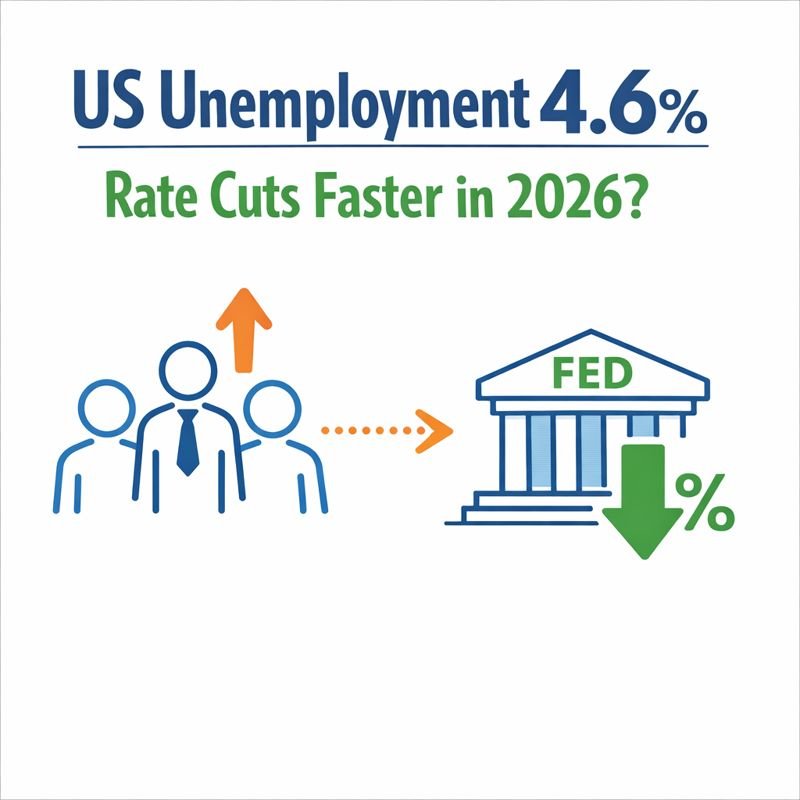
What the U.S. Unemployment Rate at 4.6% Really Means: Will the Fed Speed Up Rate Cuts in 2026?
The U.S. unemployment rate has risen to 4.6%. Does this signal a faster pace of Fed rate cuts in 2026? Here’s the structural breakdown.
Key Takeaways
✔ A 4.6% unemployment rate signals labor market cooling, not an immediate recession.
✔ The Fed’s policy focus is gradually shifting from inflation control to employment risk management.
✔ In 2026, the timing and pace of rate cuts matter more than the total number.
✔ Markets are reacting less to recession fears and more to policy easing expectations.
The U.S. unemployment rate climbed to 4.6% in December 2025, the highest level since 2021.
The data immediately raised a key question across financial markets: could this change the pace of Federal Reserve rate cuts in 2026?
Unemployment is more than just a labor statistic.
It is a core input in the Fed’s policy framework, especially once inflation begins to stabilize. That is why the 4.6% figure is drawing outsized attention from investors.
Does a 4.6% Unemployment Rate Signal Recession or Policy Transition?
According to the U.S. Bureau of Labor Statistics, the unemployment rate reached 4.6% in November.
Unlike past recessionary episodes, this increase has been gradual rather than abrupt.
The rise is driven mainly by slower hiring and longer job searches, not mass layoffs.
This suggests the labor market is cooling toward normalization rather than collapsing outright.
In that context, 4.6% should be read as a policy inflection signal, not a confirmed recession warning.
Why the Fed’s Attention Is Shifting Back to Employment
From 2022 to 2024, inflation dominated Fed decision-making.
By late 2025, however, price pressures had eased enough for employment risks to re-enter the spotlight.
Recent Fed commentary indicates that unemployment in the mid-4% range begins to matter politically and economically.
Weakness in service-sector hiring and small business employment strengthens concerns that prolonged tight policy could damage labor conditions.
Why This Jobs Report Requires Cautious Interpretation
There are technical reasons to interpret the latest data carefully.
The 2025 government shutdown disrupted parts of the labor survey process, potentially distorting short-term readings.
As a result, policymakers are likely to focus less on a single data point and more on whether the upward trend persists over multiple reports.
This approach increases near-term market volatility but improves policy accuracy.
Why Rising Unemployment Among Vulnerable Groups Matters
One notable detail in recent reports is faster unemployment growth among teens and Black workers.
Historically, these groups are affected first during labor market turning points.
This pattern suggests that labor softening may broaden over time.
For the Fed, changes in the composition of unemployment often matter as much as the headline number.
Fed Rate Cuts in 2026: Pace Matters More Than Count
Market discussions often focus on how many rate cuts will occur in 2026.
In reality, when cuts begin and how closely they are spaced matter far more for asset pricing.
If unemployment stabilizes in the mid-4% range, the Fed may proceed cautiously.
If job losses accelerate toward 5%, the pace of easing could quicken beyond current expectations.
|
Scenario |
Labor Market |
Fed Policy Stance |
Likely Market Impact |
|---|---|---|---|
|
Soft landing |
Stable mid-4% |
Gradual cuts |
Quality & dividend stocks |
|
Deeper cooling |
Approaching 5% |
Faster cuts |
Growth stocks |
|
Inflation rebound |
Employment holds |
Cuts delayed |
Value stocks, USD |
Sources: BLS, CME FedWatch, major bank research
Why Stocks Are Holding Up Despite Rising Unemployment
U.S. equities have remained relatively stable despite higher unemployment.
Markets are interpreting labor cooling as a signal of future monetary easing, not immediate earnings collapse.
The chain reaction is clear:
higher unemployment → Fed easing expectations → lower discount rates → valuation support.
That said, if labor weakness spills into consumer spending and corporate profits, this narrative could reverse quickly.
A 4.6% U.S. unemployment rate does not confirm recession.
It signals that employment risk has returned to the center of Fed decision-making.
For 2026, investors should focus less on the number of rate cuts and more on their timing and pace.
References
- U.S. Bureau of Labor Statistics – Employment Situation
- Financial Times – US unemployment rate hits four-year high
- Goldman Sachs – The Outlook for Fed Rate Cuts in 2026
- CME FedWatch Tool